

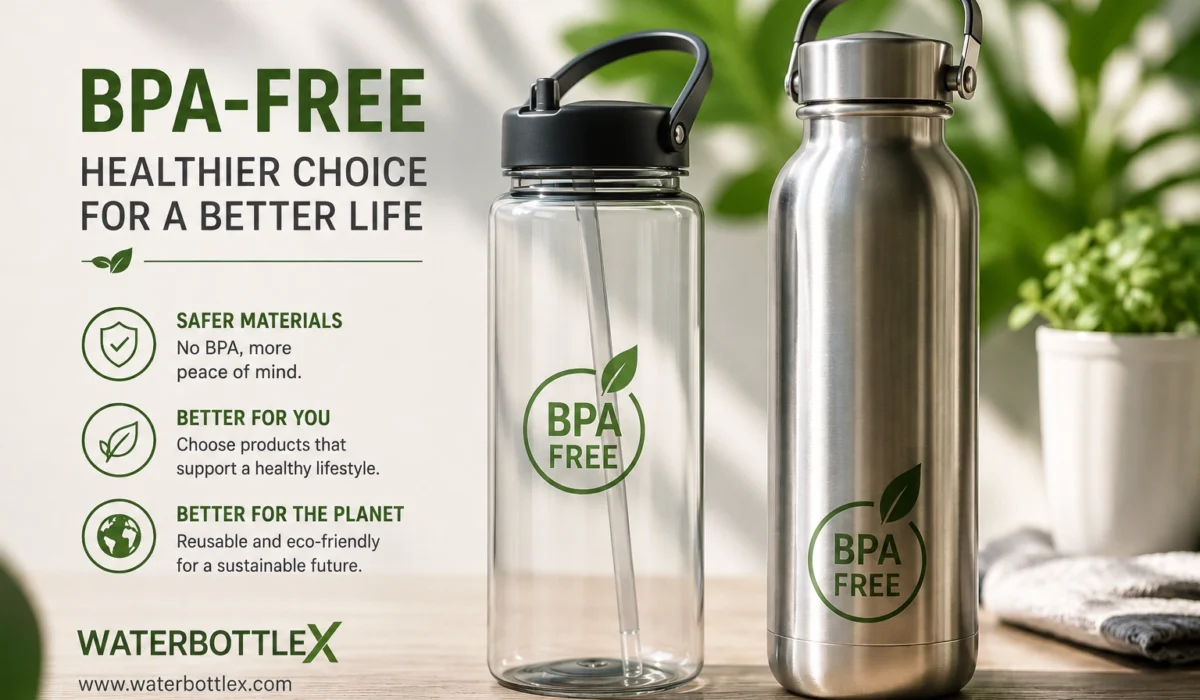
What Does BPA-Free Really Mean? And Should You Care When Buying a Water Bottle?
If you’ve ever shopped for a reusable water bottle, you’ve probably seen the words “BPA-Free” printed on the packaging.
For many people, it sounds like a good thing.
But here’s an interesting question:
How many buyers actually know what BPA is?
As a water bottle manufacturer, we’ve spoken with hundreds of customers over the years. Some specifically ask for BPA-Free bottles. Others simply assume every bottle on the market is already BPA-Free.
The reality is a little more complicated.
Why BPA Became a Hot Topic
About 15 years ago, many reusable water bottles were made from polycarbonate plastic. These bottles were lightweight, durable, and transparent.
The problem was that polycarbonate often contained a chemical called BPA (Bisphenol A).
As consumers became more health-conscious, concerns started to grow about whether BPA could migrate into food and beverages, especially when containers were exposed to heat.
News reports, scientific studies, and social media discussions quickly pushed BPA into the spotlight.
Almost overnight, consumers started asking:
“Is this bottle BPA-Free?”
The Question Buyers Ask Today
Interestingly, most of our customers aren’t asking whether BPA is dangerous.
Instead, they’re asking:
“Will my customers care if the bottle is BPA-Free?”
The answer is usually yes.
In markets like the United States, Canada, Australia, and Europe, BPA-Free has become an expected feature rather than a premium feature.
For many retailers, not mentioning BPA-Free on product packaging can actually raise concerns.
Is Stainless Steel BPA-Free?
This is one of the most common questions we receive
The answer is simple:
Yes for 304 or 18/8 stainless steel. 316 or 18/10 is better.
Food-grade stainless steel bottles do not contain BPA because they are not made from plastic.
This is one reason why stainless steel insulated bottles have become increasingly popular over the past decade.
Consumers appreciate:
* Better durability
* Better temperature retention
* No plastic taste
* BPA-Free construction
For premium brands, stainless steel has become the preferred material.
What About Plastic Bottles?
Not all plastic bottles are the same.
Modern BPA-Free bottles are commonly made from materials such as Tritan PP,PS AS.
These materials are specifically designed for food-contact applications and do not contain BPA.
In fact, many sports bottles, shaker bottles, and outdoor water bottles sold today use BPA-Free Tritan because it combines durability with a glass-like appearance.
Does BPA-Free Matter for Brands?
From a manufacturing perspective, BPA-Free is no longer just a technical specification.
It’s a marketing requirement.
When consumers compare products online, they often look for small details that make them feel confident about a purchase.
“BPA-Free” is one of those details.
It may not be the reason someone buys a bottle, but it can be the reason they don’t buy one.
That’s why most successful brands prominently display BPA-Free information on product pages and packaging.
What We Recommend to Buyers
If you’re sourcing water bottles for your brand, promotional campaign, or retail business, BPA-Free materials should be considered a basic requirement.
For premium products, stainless steel remains the most popular option.
For lightweight sports bottles, BPA-Free Tritan is often the best choice.
The key is to work with a manufacturer that can provide proper material documentation and testing reports.
Final Thoughts
The BPA discussion has changed significantly over the years.
Today, most reputable manufacturers already use BPA-Free materials.
The conversation is no longer about avoiding BPA—it’s about giving consumers confidence in the products they use every day.
For brands, that’s ultimately what matters most.
A water bottle isn’t just a container.
It’s a product people carry to work, to the gym, on hikes, and during travel.
When consumers trust the material, they trust the brand behind it.