

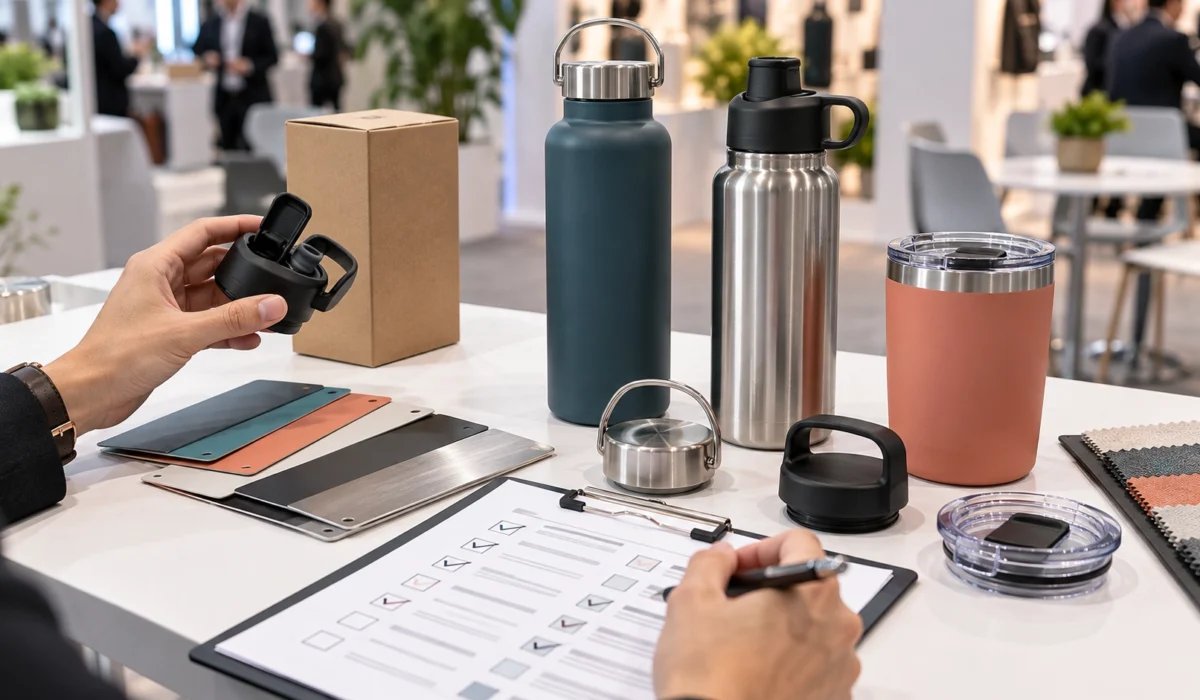
Beyond the Booth A Practical Scorecard for Comparing Custom Drinkware Samples
A busy trade-show booth makes it easy to react to color, shape and an attractive indicative price. The harder task begins later, when your team tries to remember which lid operated cleanly, which finish showed handling marks, what packaging was included and whether two quotations describe the same configuration.
The 140th Canton Fair runs in three phases in autumn 2026. Phase 2, scheduled for October 23–27, covers categories including kitchenware and tableware, household items, and gifts and premiums. For drinkware buyers, that makes early October a useful point to prepare one comparison method before supplier meetings begin.
A practical custom drinkware supplier evaluation should not attempt to prove factory capability from a booth sample alone. Its job is narrower: capture observable evidence, expose missing specifications and define what must be verified next.
Start With One Reference Brief
Before scoring any sample, write down the intended user, sales channel, target capacity, material preference, lid type, finish, branding method, packaging format, destination market and estimated order quantity. Mark each requirement as essential, preferred or open to alternatives.
Use the same brief with every serious supplier. A commuter tumbler, a promotional bottle and a retail insulated flask should not be judged against the same priorities. The scorecard becomes useful only when the target product remains constant.
Use a Consistent 1 to 5 Scale
Score 1 when a sample clearly misses the brief or leaves a major concern unresolved. Score 3 when it appears workable but needs evidence or revision. Score 5 only when the sample fits the requirement and the supplier can identify the exact configuration. Add a short observation beside every score; a number without context will not help colleagues after the fair.
| Criterion | Inspect | Record | Score |
| Product fit | Capacity, proportions, weight, opening, grip and intended use | Exact sample or model code; essential deviations | 1–5 |
| Construction and lid | Assembly, threads, seals, moving parts and ease of operation | What was tested at the booth; what needs a functional sample | 1–5 |
| Finish and color | Coverage, texture, edge treatment and visible handling marks | Finish name or reference; color approval route | 1–5 |
| Logo execution | Position, scale, contrast, edge definition and surface suitability | Decoration method, artwork limits and requested proof | 1–5 |
| Packaging fit | Protection, product movement, presentation and label space | Included pack-out; changes required for the sales channel | 1–5 |
| Specification record | Material, capacity, dimensions, components and options discussed | Documents or technical details still required | 1–5 |
| Next sample request | Changes needed to create a comparable evaluation sample | Version, deadline, owner and quotation assumptions | 1–5 |
Handle the Product Like Its End User
Open and close the lid several times. Check whether parts align naturally and whether the drinking interface suits the intended use. Look at threads, seals, hinges, handles and removable components. If the booth conditions do not allow a fill or leak check, record that limitation and request a functional sample rather than treating a visual inspection as proof of performance.
Inspect Finish Logo and Packaging Together
View coated and printed surfaces under even light and after normal handling. Check transitions around shoulders, bases, rims and textured areas. For the logo, record the actual decoration method and assess placement, contrast and edge definition on that specific surface. A strong print on one finish does not automatically predict the same result on another.
Then place the product in its proposed packaging. Note movement, protection around the lid and base, presentation when opened, label space and carton assumptions. Packaging changes can affect the quotation and the product experience, so they belong in the same comparison rather than a separate late-stage conversation.
Record the Configuration Not Just the Impression
Photograph sample codes and relevant details with permission. Record the material description, nominal capacity, dimensions, lid version, finish, logo method, accessories and packaging discussed. Ask the supplier to identify which points are standard, optional or subject to development. Where food-contact, performance or market requirements matter, list the evidence to review for the selected materials and configuration; do not assume a general document covers every product.
End Every Meeting With the Next Sample Defined
The most useful outcome is not the highest booth score. It is a short list of candidates that can be compared under the same scope. Before leaving, specify the sample version you need, requested changes, artwork, packaging, quantity basis, quotation inclusions, responsible contact and follow-up date.
After the fair, compare suppliers criterion by criterion. Keep high scores separate from unresolved evidence. A visually impressive sample may still require too many assumptions, while a less dramatic model may provide the clearest route to a controlled, market-ready product.
Turn the Shortlist Into Comparable Requests
Bring your defined brief and scorecard to supplier meetings, then share the shortlisted configuration with WaterBottleX. We can discuss product selection, logo and finish options, packaging requirements, sample needs and a quotation based on the same written scope. Explore WaterBottleX customization options.