

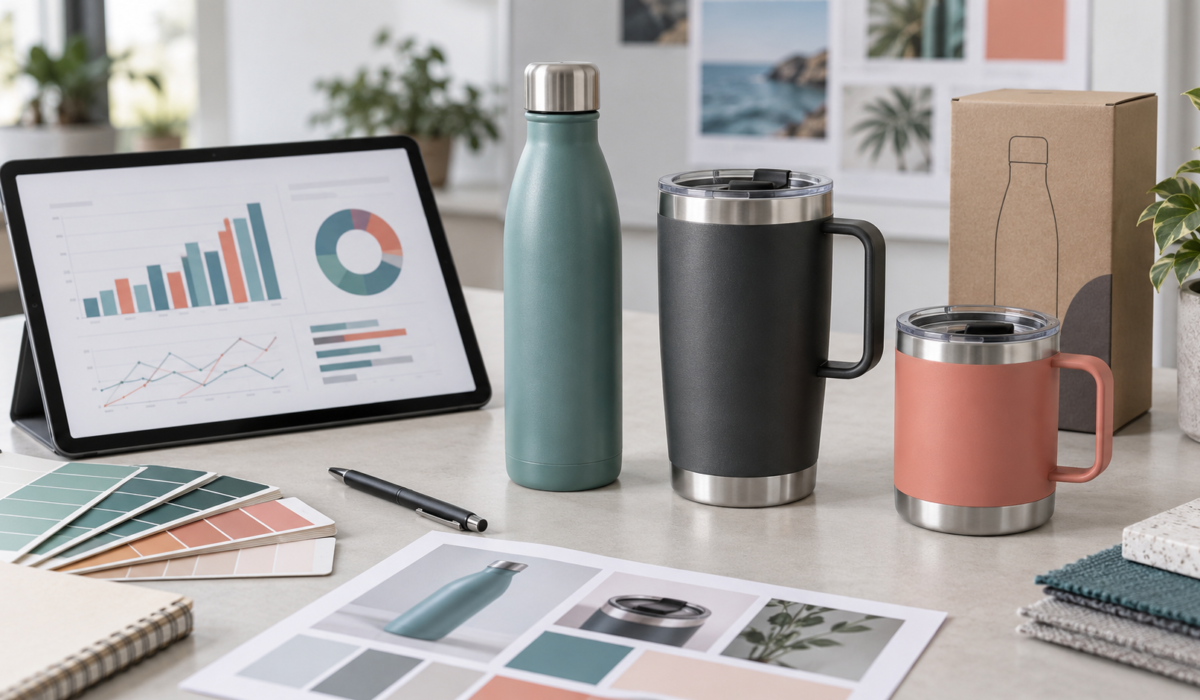
A seasonal sales review should do more than identify the top-selling bottle. For a brand preparing its next range, the more useful question is why one configuration worked, where another created friction, and which findings can be translated into a clearer manufacturing brief.
Early September is a practical point to bring commercial, customer-service and operations teams together. Summer demand has produced real evidence, while there is still time to use those lessons in future product planning. The following six signals can make a custom drinkware product development conversation more specific and productive.
1. Sell-through by configuration, not only by product name
Break performance down by the decisions that define each SKU: capacity, lid style, color, finish, handle, packaging and sales channel. A strong result for a 750 ml handled bottle does not automatically mean every large-capacity format will perform in the same way.
Look for combinations. Perhaps a restrained color sold steadily through office-focused retailers, while a brighter version moved mainly during short promotions. Those patterns can guide which elements remain standard, which become channel-specific, and which deserve a new sample.
2. Stockouts, replenishment and markdown timing
Final sales totals can hide the shape of demand. A SKU that sold out early may have had more potential than its volume suggests. Another may appear successful only after a late markdown. Record when inventory ran short, when buyers reordered and when discounting accelerated.
This context helps separate a product decision from an inventory decision. It can also inform a more disciplined quantity discussion by SKU, rather than spreading volume evenly across every color or capacity.
3. Returns and customer-service contacts
Return codes are most useful when the team reads the underlying comments. Group issues into categories such as size expectations, lid operation, cleaning, packaging damage, finish appearance or product-page misunderstanding. Avoid treating every return as a manufacturing defect; the cause may sit in product design, merchandising, instructions or fulfilment.
For the next brief, convert repeated issues into questions and acceptance criteria. That might mean reviewing lid operation on the physical sample, checking how the bottle fits its insert, or clarifying dimensions and use instructions on the retail page.
4. Reviews, questions and the language customers use
Customer reviews often reveal which attributes buyers notice after daily use. Search for repeated references to grip, carrying, cup-holder fit, drinking flow, weight, cleaning and perceived size. Customer questions are equally valuable because they show what the product page or packaging did not explain clearly.
Share the pattern with the manufacturer, not a collection of isolated quotes. A recurring observation can support a design review; a single unusual request should not redirect the whole range without broader evidence.
5. Differences between channels, regions and use cases
The same bottle can play different roles in retail, e-commerce, corporate gifting and distribution. Compare performance and feedback by channel where the data allows. Packaging that works on a store shelf may need a different structure for individual parcel delivery, while a promotional buyer may prioritize logo visibility and presentation.
Regional or channel variation should lead to a defined requirement, not a vague request to make the product more universal. Identify which market needs the change, how the item will be sold and which product or packaging detail is affected.
6. Margin and operational friction
A popular SKU can still create hidden work. Review assembly time, packaging complexity, damage handling, customer-service effort, inventory fragmentation and the cost of maintaining slow colorways. These factors help determine whether to simplify a range, adjust packaging or keep a high-volume configuration unchanged.
The goal is not to remove every variation. It is to ensure that each SKU has a clear commercial role and that additional complexity earns its place.
Turn the Review Into a Decision-Ready Brief
A useful manufacturer brief does not need to include a full analytics dashboard. Summarize the evidence and connect it to decisions. Include:
Target customer, use case and sales channel
Best- and worst-performing product configurations
Repeated returns, questions and review themes
Elements to retain, investigate, change or discontinue
Desired capacities, lids, colors, finishes, branding and packaging
Estimated quantity by SKU, destination markets and intended launch window
Required product documentation and your sample-approval process
WaterBottleX supports OEM and ODM development, customization, samples, packaging and private-label projects. Recommendations, schedules, quantities and documentation should be confirmed for the chosen product and destination market.
Use Evidence to Improve the Next Product Decision
Summer sales data cannot design a product on its own, but it can replace assumptions with a sharper set of questions. Review the commercial result, identify the repeatable signals and give each requested change a clear reason. That creates a stronger starting point for sampling, quotation and cross-functional approval.
Planning your next drinkware range? Share your target customer, sales channels, key summer findings, estimated quantities, destination markets and launch window with WaterBottleX: https://waterbottlex.com/contact-us/