

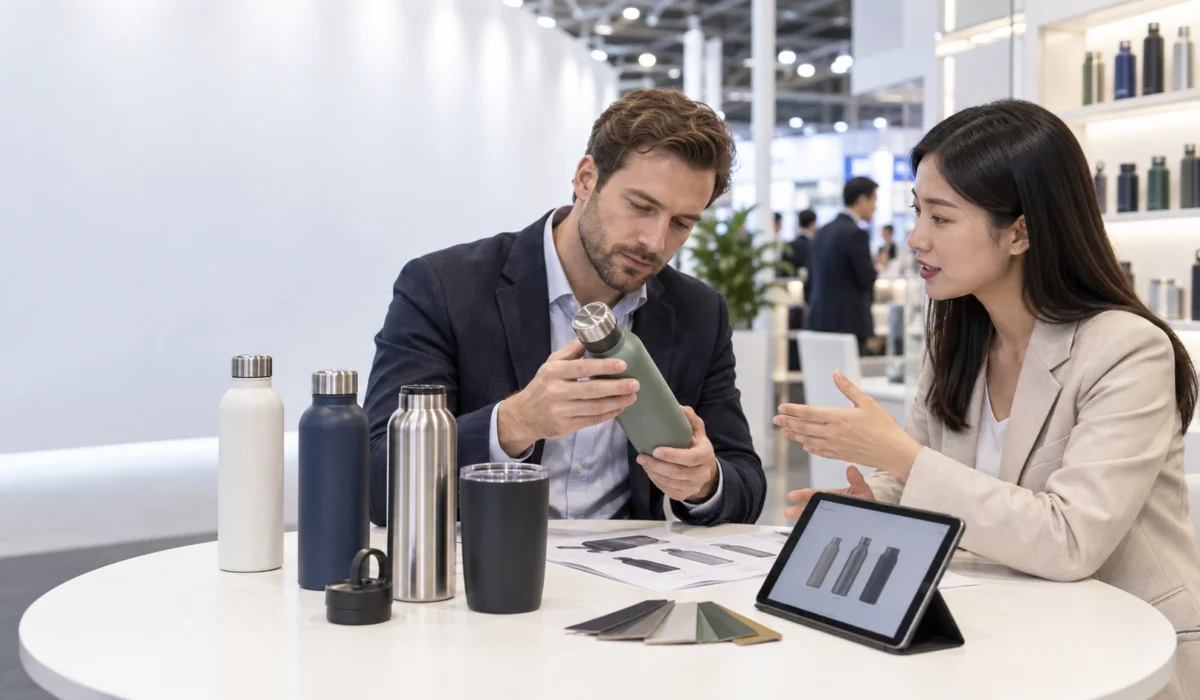
A trade-show booth can place dozens of bottles, tumblers, lids, finishes, and packaging options in front of you within minutes. That access is valuable, but it can also produce a collection of catalogues and quotations that are difficult to compare once the trip is over.
A productive drinkware supplier meeting begins before you reach the exhibition hall. By preparing a focused sourcing brief and asking the same core questions at each meeting, you can identify which suppliers understand the commercial requirements behind your product.
The 140th Canton Fair will take place in three phases from October 15 to November 4, 2026. Phase 2, scheduled for October 23–27, includes housewares, kitchenware and tableware, gifts, and related categories, making it especially relevant to many drinkware buyers. Buyers should confirm their appropriate phase and registration details through the official Canton Fair website.
Define What You Need Before Reviewing Products
“Show me your best bottle” is rarely a useful starting point. The supplier does not yet know whether you are developing an outdoor retail line, an employee gift, a promotional campaign, or a high-volume private-label product.
Prepare a one-page brief containing:
- Target customer and sales channel
- Intended use case and price position
- Preferred capacity, material, lid, and handle style
- Estimated quantity by SKU
- Required colors, finish, logo method, and packaging
- Destination markets and target arrival date
- Documentation or testing requirements that need to be discussed
- Whether you want an existing model, a modified design, or a new product concept
Separate essential requirements from preferences. This makes it easier to evaluate alternatives when a supplier recommends a different construction, finish, or customization route.
Research Suppliers and Request Meetings in Advance
Use the fair’s official exhibitor and product search tools to build a shortlist before travelling. Prioritize suppliers whose product categories and manufacturing capabilities match your brief rather than scheduling meetings solely around attractive catalogue images.
Send shortlisted suppliers a concise introduction. Include your product category, expected quantities, customization level, destination market, and the questions you want to cover. Ask what samples, finish references, packaging examples, or technical information they can have available.
Advance contact also reveals how clearly a supplier handles a structured enquiry. It does not replace factory verification, but it can help you use your exhibition time more deliberately.
Bring Questions That Expose the Real Project Path
A unit price without its assumptions has limited value. During each drinkware supplier meeting, establish exactly what the indicative quotation includes.
Ask about the MOQ for the specific model and each color or artwork variation. Confirm whether color matching, logo application, individual packaging, accessories, and export cartons are included. For custom development, discuss engineering, tooling, prototype rounds, and who owns the approved drawings and molds.
Sampling questions should be equally precise:
- Will the sample use production-intent materials and components?
- Can the intended color, finish, and branding method be sampled together?
- Which details must be approved before mass production?
- How are later changes documented and priced?
- What reference will production and quality teams use?
Avoid treating every encouraging answer as a commitment. Record which points are confirmed, which are estimates, and which require technical review after the fair.
Inspect Samples as a Buyer, Not a Visitor
Handle the product as your customer would. Open and close the lid, check how the handle moves, examine seams and surface transitions, and consider cleaning and everyday portability. For retail or gifting projects, review the packaging alongside the bottle.
A booth sample demonstrates a product direction; it does not automatically confirm the specification or quality of your eventual order. Note the exact model or sample code and photograph relevant details with permission. If you request a quotation later, attach those references so both parties are discussing the same configuration.
For food-contact materials, performance claims, or destination-market requirements, ask what documentation is available for the selected product. The applicable evidence should be reviewed for your actual materials, components, intended use, and market rather than assumed from a general certificate shown at the booth.
Use One Scorecard for Every Supplier
Trade-show impressions fade quickly. Create a short scorecard that covers product fit, customization capability, communication quality, sampling approach, quality-control process, commercial terms, documentation, and follow-up actions.
Use the same criteria for every serious candidate. This helps your team distinguish an engaging sales conversation from evidence that a supplier can support the project.
Before leaving each meeting, agree on the next exchange: revised specifications, an itemized quotation, sample availability, required artwork, or a technical call. Assign a deadline and record the contact responsible.
Follow Up With a Written Project Summary
Within a few days, send each shortlisted supplier a written recap. State the model discussed, requested changes, quantities, colors, branding, packaging, destination, and timing. Attach photographs or references where appropriate and ask the supplier to identify assumptions or missing information.
This follow-up becomes the starting point for a proper comparison. Suppliers should be assessed against the same scope, not against quotations built around different bottles, packaging formats, or delivery terms.
A good Canton Fair meeting is not measured by the number of samples you see. It is measured by how quickly the discussion can become a clear, verifiable development plan.
Planning a custom drinkware sourcing project? Share your brief with WaterBottleX to discuss suitable OEM, ODM, customization, sampling, and packaging options: Contact WaterBottleX.